Can You Be Held Liable If a Branch From Your Tree Falls on a Neighbor's Property in Colorado?
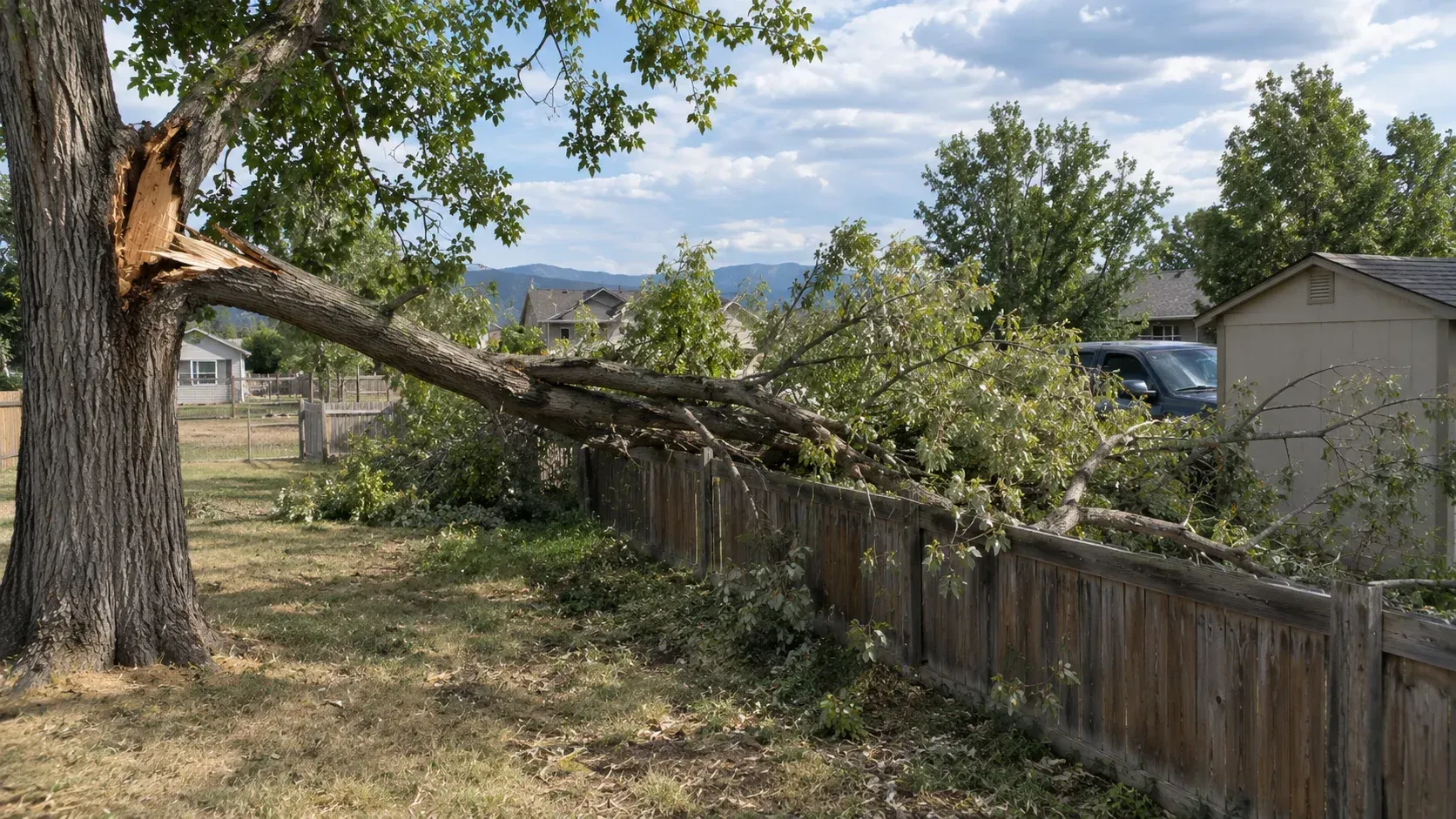
Table of Contents
- Introduction
- What happens when a tree branch falls on a neighbor's property
- How tree damage liability is actually decided
- The two words that decide most cases
- What counts as knowing a limb was hazardous
- What neighbor tree laws say about branches crossing the line
- Colorado wind and heavy wet snow change the risk picture
- Insurance, and who ends up paying
- Documentation protects whoever has it
- What to do if a neighbor raises a concern
- Conclusion
- Schedule a Tree Risk Assessment Before the Next Windstorm
- Frequently Asked Questions
Key Takeaways
- A tree owner in Colorado can generally be held liable when a tree branch falls on a neighbor's property only if they knew, or reasonably should have known, the limb was hazardous and failed to act.
- A healthy tree that fails in an unusual storm with no prior warning signs is usually treated as an act of nature rather than negligence.
- Notice is what shifts the balance. Once a neighbor tells you about a dead limb, or the hazard is plainly visible, "I did not know" stops being available.
- Under neighbor tree laws, a neighbor may generally trim encroaching branches back to the property line at their own cost, but cannot enter your property or kill the tree.
- Records matter on both sides. An inspection and a paid invoice are evidence of reasonable care; a text message about a dead limb is evidence of notice.
Introduction
In Colorado, you can generally be held liable when a tree branch falls on a neighbor's property only if you knew, or reasonably should have known, that the tree or limb was hazardous and you failed to do anything about it. A structurally sound tree that loses a limb in a genuine windstorm, with no prior warning signs, is usually treated as an act of nature rather than as negligence. That distinction between an unforeseeable failure and an ignored one is the whole question, and it is why we build a hazard check into our tree trimming and removal work rather than waiting for someone to call after a storm.
We are a tree and property service, not attorneys, so this is an orientation to how the standard generally works rather than legal advice on your situation. For anything active, talk to an attorney and your insurer.
Here is what tends to decide these cases, and what you can do now to stay on the right side of it.
What Happens When a Tree Branch Falls on a Neighbor's Property
When a tree branch falls on a neighbor's property in Colorado, responsibility generally sorts into one of three outcomes:
- No liability. A healthy, sound tree failed in a genuine storm with no prior warning signs. Treated as an act of nature, and each party's own insurance typically handles their own damage
- Likely liability. The limb was visibly dead, decayed, or already flagged, and nothing was done. The owner knew or should have known, which is the standard that matters
- Disputed. The condition was arguable, or notice is contested. This is where documentation on either side decides it
Notice that none of the three turns on where the branch landed or how expensive the damage was. The question is always the condition of the tree beforehand and what the owner did about it.
How Tree Damage Liability Is Actually Decided
Tree damage liability is not decided by whose tree it was or where the branch landed. It is decided by whether the owner acted reasonably given what they knew or should have known.
Broadly, a claim tends to look at:
- Condition of the tree before the failure. Was it dead, diseased, decayed, or structurally compromised?
- Visibility of that condition. Could a reasonable homeowner have seen it from the ground?
- Notice. Had anyone told the owner, in any form?
- Action taken. Did the owner do anything after learning of it, and how quickly?
- The weather event itself. Was it ordinary wind or a genuinely extraordinary storm?
Put those together and a pattern emerges. Healthy tree plus severe storm generally favours the tree owner. Visibly dead limb plus ordinary wind generally does not.
The Two Words That Decide Most Cases
"Should have known" is the phrase that does the work, and it is the part homeowners underestimate.
You do not have to have been told for liability to attach. If a hazard was obvious enough that a reasonable person maintaining their property would have noticed it, the law can treat you as having known. That is why "nobody ever complained" is a weaker position than people expect.
The practical implication is straightforward:
- Ignorance is only a defence if the condition was genuinely not apparent
- Never looking at your trees does not preserve the defence, it undermines it
- Periodic inspection is what converts "should have known" from a risk into a record of care
This cuts in a reassuring direction too. If you inspect, act on what you find, and keep the receipts, an unexpected failure looks like what it is.
What Counts as Knowing a Limb Was Hazardous
These are the situations where notice is usually considered established:
- A neighbour mentions it, in person, by text, by email, or in a letter
- An arborist or tree service has previously flagged the tree
- A limb has already partially failed, cracked, or dropped once
- Large deadwood is visible in the canopy from the ground
- The trunk shows a cavity, seam, or significant decay
- Mushrooms or fungal brackets are growing at the base or on the trunk
- The tree has developed a new lean, or soil is cracked or heaved on one side
- A codominant union shows a bark seam that is separating
- The tree is dead, which is the clearest case of all
Two of those deserve emphasis because they are the ones we see ignored most often. A limb that has already dropped once is a warning that has been delivered. And a dead tree standing over a fence line is close to the definition of a foreseeable hazard.
What Neighbor Tree Laws Say About Branches Crossing the Line
Encroachment is a separate question from liability for a fall, and it is where most neighbourly friction actually happens.
The general principles across most jurisdictions:
- A neighbour may usually trim branches and roots back to the property line at their own expense
- They generally may not enter your property to do it without permission
- They generally may not trim in a way that kills or destroys the tree, which can create their own liability
- A tree growing on the boundary line itself is often treated as jointly owned, which means neither party can remove it unilaterally
- Fruit and debris rules vary, and falling leaves and needles are usually treated as a fact of life rather than a wrong
So a neighbour with overhanging branches typically has a self-help remedy at their own cost, and that is often the fastest resolution. What they cannot generally do is send you the bill for trimming they chose to do, absent an agreement.
Where the branch is over a fence, a shed, a vehicle, or a play area, our advice is simply to deal with it. The cost of removing a limb is almost always less than the cost of arguing about who owed what after it lands.
Colorado Wind and Heavy Wet Snow Change the Risk Picture
The regional conditions here are genuinely relevant to the foreseeability question, because they make failures more predictable rather than less.
- Front Range wind events, including strong downslope winds, load trees far beyond an average breeze. A limb that survives normal weather is not thereby proven sound
- Heavy wet spring and fall snow is the classic limb-breaker. Snow loads a canopy that still has leaves or dense needles, and the weight arrives fast
- Drought stress weakens trees and increases deadwood, and our dry stretches are hard on unirrigated trees
- Insect and disease pressure, which leaves standing deadwood in a canopy
- Wildfire risk, which is why our own tree page frames the work around reducing wildfire risk and eliminating hazardous branches
Why this matters legally as well as practically: in a region with predictable wind and known wet-snow events, "it was windy" is a weaker explanation than it would be somewhere calm. A limb that was already compromised failing in weather the area gets most years is closer to foreseeable than to freak.
The timing point follows from that. Dealing with deadwood before wind and snow season is both the cheaper and the more defensible sequence.
Insurance, and Who Ends Up Paying
This is where expectations most often diverge from reality, so it is worth setting out plainly. Every policy differs, and your carrier is the authority.
Common patterns:
- Damage to a neighbour's structure from your tree is frequently claimed first on the neighbour's own property policy
- That carrier may then pursue you or your insurer if it believes negligence was involved
- Where no negligence is found, each party's own policy tends to carry its own damage
- Removal of the fallen tree or limb itself is often treated differently from the damage it caused, and coverage varies
- Damage to a fence, shed, or vehicle can fall under different parts of a policy than damage to a house
Three things worth doing before you need any of this:
- Call your agent and ask specifically how your policy treats tree damage to a neighbour's property
- Ask whether the carrier expects any tree maintenance as a condition of coverage
- Check your liability limit, since a tree through a roof is not a small claim
Documentation Protects Whoever Has It
The record is often what decides these disputes, and it is created before anything happens.
What helps you:
- Dated photos of your trees, taken periodically
- Written assessments or recommendations from a tree service
- Invoices showing work performed, and when
- A note of what you were told and what you did about it
- Evidence that you acted promptly once you learned of a problem
What creates exposure:
- A neighbour's text or letter about a limb, with no follow-up from you
- A recommendation you received and did not act on
- A long gap between being told and doing anything
- Repeated partial failures with no intervention
The asymmetry is worth internalising. A neighbour who texts you a photo of a dead limb has just created a dated record of notice. From that moment, the reasonable response is to get it looked at, not to decide privately that it is fine.
What to Do If a Neighbor Raises a Concern
A practical sequence, in order:
- Take it seriously and say so. A written acknowledgement that you are looking into it is better than silence
- Get it assessed rather than deciding from your own driveway
- Act on the finding, and keep the invoice
- Tell the neighbour what you did. This defuses most disputes entirely
- If you disagree with the concern, get that in writing from someone qualified rather than relying on your own view
- If damage has already occurred, notify your insurer promptly and talk to an attorney before agreeing to anything
We are happy to evaluate trees and give honest recommendations, including telling you a tree is sound and does not need work. That answer is worth having on paper too.
Conclusion
Liability when a tree branch falls on a neighbor's property in Colorado generally comes down to notice and response. Knew or should have known, plus failed to act, is the shape of the test. A sound tree that fails in a real storm is usually nobody's fault; a dead limb somebody mentioned in September that lands in November is a different conversation.
Two habits cover most of the risk. Look at your trees on some kind of schedule, particularly the ones over a fence line, a driveway, or a structure. And when something gets flagged, whether by a neighbour or by your own eyes, get it assessed and keep the record. Both are inexpensive compared with the alternative.
Schedule a Tree Risk Assessment Before the Next Windstorm
If you have a tree leaning over a neighbour's fence, a limb you have been meaning to deal with, or a note from next door you are not sure how to answer, let us take a look. Sticky Nicky's Mowing and Property Services evaluates trees and gives honest recommendations, including when the answer is that nothing needs doing. We trim, remove, grind stumps, correct grading and erosion, and either haul the debris or run it through our chipper for mulch. Call (719) 238-8194, Monday to Saturday, or
get in touch. We work across Calhan, Colorado Springs, Falcon, Fountain, Cimarron Hills, and Castle Rock, and you can confirm coverage on our
service areas page.
Frequently Asked Questions
Am I liable if my tree branch falls on my neighbor's property?
Generally only if you knew or reasonably should have known the limb was hazardous and did not act. A sound tree failing in a genuine storm is usually treated as an act of nature. Speak with an attorney and your insurer about your situation.
What if my neighbor told me about the branch beforehand?
That establishes notice, which is the factor most likely to shift responsibility toward you. The reasonable response is to have the tree assessed promptly and keep a record of what was found and what was done.
Can my neighbor cut branches that hang over their yard?
Usually they may trim back to the property line at their own expense, without entering your property and without killing the tree. They generally cannot bill you for trimming they chose to do unless you agreed to it.
Does homeowners insurance cover a tree falling on a neighbor's house?
It varies by policy. Damage is often claimed first on the neighbour's own policy, which may then pursue you if negligence is alleged. Ask your agent specifically how your policy handles tree damage to adjacent property.
How often should I have my trees checked?
There is no single interval, but trees over a fence line, driveway, structure, or play area warrant a look every few years and after any significant wind or heavy wet snow. Any tree with a known defect needs a shorter cycle.